

『Hedland Variable Area Flow Meter Working Principle: Sharp-Edged Orifice and Spring Mechanics』Related information(flow rotameter|digital flow meter|balo meter|hydraulic flow meter|volumetric meter|positive displacement meter|pitot tube flow meter|displacement meter|cfm meter|variable area flow meter|inline flow meter|differential pressure flow meter|calibrated flow meter|velocity meter|paddle wheel flow meter|oval gear flow meter|anemometer hvac|multiphase flow meter|doppler flow meter|thorpe tube flowmeter|heat flow meter)
Hedland Variable Area Flow Meter Working Principle: Sharp-Edged Orifice and Spring Mechanics
Quick Answer: A Hedland variable area flow meter uses a sharp-edged orifice and a spring-loaded piston to turn flow rate into a linear position change. The orifice creates a pressure drop, and the spring resists piston movement. The piston position shows flow rate on a direct reading scale without power or electronics.
Silver Automation Instruments supplies industrial flow meters to customers in Southeast Asia, Oceania, Latin America, Africa, and the Middle East. Many engineers ask us about Hedland type meters when they need a simple local display for oil, water, air, or hydraulic circuits. This article explains the sharp-edged orifice and spring mechanics so you can judge whether the meter fits your process.
What Happens Inside the Meter
Flow enters the meter body from the inlet side. The meter body has a sharp-edged orifice in the flow path. A spring-loaded piston sits downstream of the orifice. When flow starts, the sharp-edged orifice restricts the fluid. This restriction creates a pressure difference between the inlet side and the outlet side.
That pressure difference pushes against the piston. The piston compresses a calibrated spring. Higher flow creates more differential pressure. More differential pressure moves the piston further along its travel. The piston position is linear enough to read on a scale. A magnetic coupling or direct visual indicator shows the position on the meter body.
The Sharp-Edged Orifice and Spring Mechanics
The sharp-edged orifice is a flat plate with a clean bore edge. It is not a cone or a nozzle. This shape gives a predictable pressure drop over a wide flow range. The discharge coefficient stays stable in turbulent flow. The spring provides the opposing force. Spring rate, orifice bore, and piston area determine the flow range.
For a meter size such as DN15 or DN25, the spring can be changed to match a different flow span. That is why Hedland type meters are offered in many ranges for lube oil, water, air, and hydraulic oil. The scale can be calibrated in lpm, gpm, m3/h, or scfm.
Why This Principle Works Without Power
Variable area flow meters with a sharp-edged orifice and spring do not need a 4-20 mA HART output or 24 V DC supply to show flow. The process energy moves the piston. The visible scale gives a direct indication. This is useful on hydraulic power units, bearing lubrication lines, cooling water skids, and air compressor packages. Operators see flow at a glance without opening a control panel.
In practice, maintenance teams in Southeast Asia have used these meters on heat exchanger cooling water circuits because a transmitter was overkill. No loop check, no PT100 wiring, no output signal issue.
Viscosity, Specific Gravity, and Calibration Effects
The meter responds to differential pressure. Fluid density and viscosity change the indicated flow. A meter calibrated for 50 cP hydraulic oil will not read correctly on water without a correction. Specific gravity affects the pressure drop for a given actual flow. Heavier fluids move the piston differently at the same volumetric flow.
When you send us an inquiry, tell us the fluid type, viscosity in cP, operating temperature in °C, pressure in bar, pipe size in DN, and required flow range in kg/h or lpm. We can help with selection or suggest another meter type if the Hedland style is not suitable.
Installation Notes and Field Experience
Mount these meters with a straight run if possible. The sharp-edged orifice design is less sensitive to
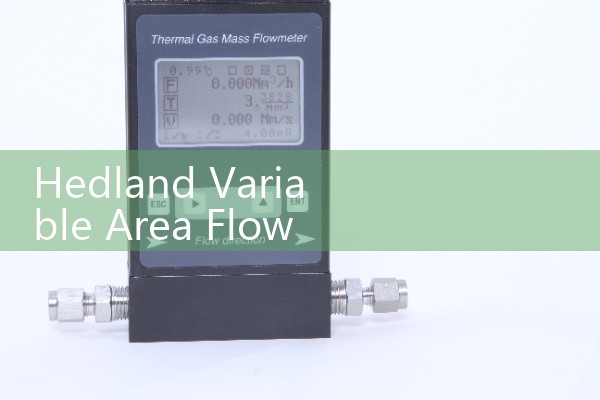
Use flow straighteners or a 10D straight run for best accuracy. For high pressure hydraulic lines, check the meter body and seal material. Many Hedland style meters are rated up to 240 bar depending on the model. Always verify the pressure and temperature limits for your version.
How to Select a Hedland Type Variable Area Flow Meter
We often quote this meter type for local indication on oil, water, diesel, and air. The selection inputs are flow range, fluid, viscosity, pressure, temperature, connection size, and whether you need an optional pulse output or 4-20 mA transmitter. The base unit has no electronics.
A customer in Vietnam asked us for a local flow indicator on a diesel line with DN20 pipe, 10 to 100 lpm flow, 4 bar pressure, and 40 °C temperature. We selected a meter with BSPP threads and the correct piston range. The customer installed it on the return line. It showed flow without any power supply. That solved the problem on the first try.
Limitations Compared to Other Flow Meters
The sharp-edged orifice and spring mechanism is simple but not a high accuracy meter. Accuracy is typically around 2% to 5% of full scale. It is not a custody transfer meter. It does not measure mass flow directly. For mass flow, a Coriolis mass flow meter is better. For no moving parts and high rangeability, an electromagnetic flow meter for water or a thermal mass flow meter for air may be the right choice.
For dirty fluids, the sharp-edged orifice and piston can catch debris. A strainer is often required. For slurries or fluids with particles, use a clamp-on ultrasonic flow meter or a full bore electromagnetic flow meter instead. Silver Automation Instruments supplies these alternatives with factory calibration certificates.
FAQ: Hedland Variable Area Flow Meter Working Principle
Can a Hedland flow meter work without electricity? Yes. The flow force moves the spring-loaded piston. A local scale shows the reading. No 24 V DC supply, no 4-20 mA loop, and no RTD wiring are needed for the base unit.
Which fluids work with the sharp-edged orifice and spring design? Clean liquids and gases work well. Common examples are hydraulic oil, diesel, water, air, nitrogen, and lubricating oil. Dirty fluids can block the small clearance around the piston.
How does viscosity affect the reading? High viscosity changes the pressure drop across the sharp-edged orifice. The meter must be calibrated for the operating viscosity. A meter set for 30 cP oil will not read correctly on 1 cP water unless you apply a correction.
Can I use the same meter for oil and water? Not without checking the calibration. Specific gravity and viscosity differences change the piston position for the same volumetric flow. Tell us the fluid for each service.
What is the typical accuracy of this meter type? Accuracy is normally 2% to 5% of full scale. It works well for local indication and alarm, but not for fiscal metering or high precision batching. Use a Coriolis mass flow meter for mass accuracy below 0.5%.
Send your pressure in bar, temperature in °C, pipe size in DN, flow range in kg/h or lpm, fluid name, and viscosity in cP to Silver Automation Instruments. Our team can check your application and recommend a Hedland type variable area flow meter or a better alternative. Tel: +86-25-68650347. Whatsapp: +86-25-52155837. WeChat: +86 15365082610.
 Hot News
 Related AD